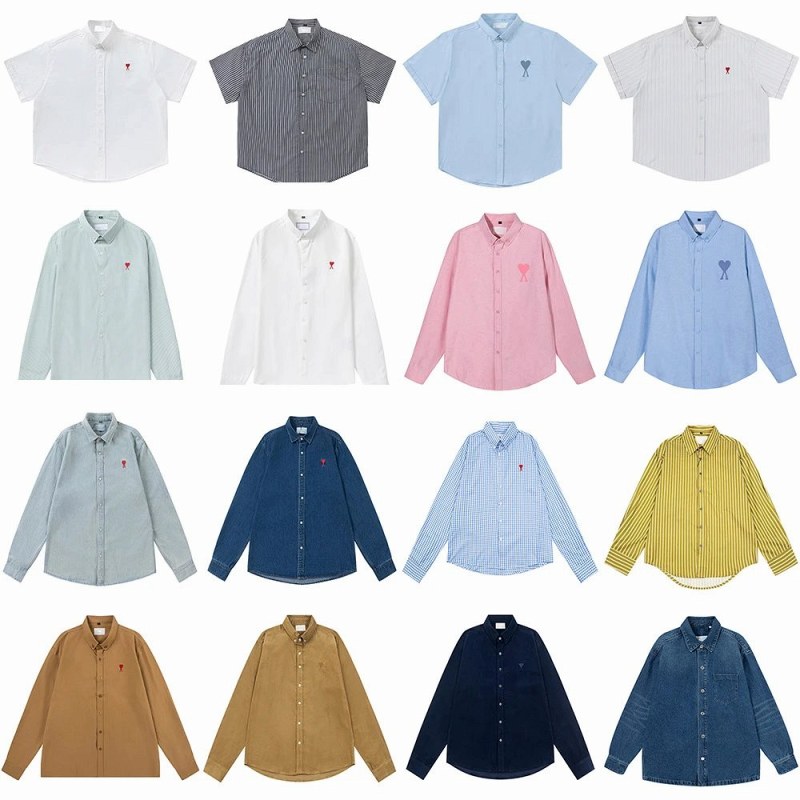
We ordered this one because of a blank cell. The spreadsheet row for the Ami Paris check multicolor T-shirt collection carries a price of $29.40, stays in stock, lists sizes S–XL across 37 colour entries, and gives a shipping weight of 0.00 g. A zero there is not a light garment; it is a missing field, and a missing field is what our bench exists to fill in. So two editors unpacked five pieces on the Rotterdam bench — four sizes in the blue check code and one size L in the pink check — and started measuring before anything went near a mirror.
What the row promised and what the parcel held
The attribute sheet describes a loose-cut, cardigan-style top with a lapel collar, long sleeves, Oxford cloth, embroidery and a breathable function. The title says T-shirt collection. What arrived in the blue check was a long-sleeve collared piece with a buttoned front placket and a chest motif — closer to the attribute sheet than to the title. That gap is not a shipping error on our order; it is a listing inconsistency you should settle with your agent before you buy, because a short-sleeve crew and a long-sleeve placket layer are not interchangeable in a wardrobe.
Build quality at this price was better than we expected. The check matched across the placket, the collar sat level, and no piece arrived with a crease that survived twenty minutes on the bench. All five came in one consolidated carton, folded flat, with no hanger marks.
The 0.00 g weight field
The listing gives no usable shipping figure, so we put a size L on the postal scale ourselves: 386 g for the garment alone and 428 g in its individual poly mailer. That matters most if you are building a consolidated parcel, because a 0.43 kg line item is the sort of thing that quietly pushes a haul into the next freight bracket. Our size S came in at 341 g and the XL at 411 g, so the weight steps up roughly 25 g per size. Budget half a kilo per piece, not the zero the sheet displays.
Flat measurements and the size-chart delta
We laid each piece flat, let it rest twenty minutes after unpacking, and measured pit-to-pit across the chest, shoulder seam to shoulder seam, sleeve from the seam, and centre-back length to the hem. Deltas against the listing chart are recorded, not rounded away.
| Size | Chest (chart / measured) | Shoulder | Sleeve | Length (chart / measured) | Delta |
|---|---|---|---|---|---|
| S | 56 cm / 55.0 cm | 47.5 cm | 58.5 cm | 68 cm / 67.6 cm | −0.4 cm |
| M | 58 cm / 57.2 cm | 49.5 cm | 59.0 cm | 70 cm / 69.4 cm | −0.6 cm |
| L | 60 cm / 59.0 cm | 52.0 cm | 60.0 cm | 72 cm / 71.2 cm | −1.0 cm |
| XL | 62 cm / 63.0 cm | 53.5 cm | 61.0 cm | 74 cm / 73.0 cm | −1.0 cm |
Every garment measured slightly under its chart figure, and the drift widens as the size goes up. Sizing down would be the wrong reaction: the cut is deliberately loose, the shoulder is dropped, and one of our two editors — 178 cm, 74 kg — wore the M comfortably over a heavyweight tee. The other, 172 cm and narrower through the chest, preferred the S with the placket buttoned. The published AMI guidance of taking your usual size, with a labelled 42 reading as a typical Large, matched what we felt on the bench.
Three rows, one comparison
The point of a spreadsheet habit is comparison, so we set this listing against the two nearest rows in our own sheet: a solid crew-neck tee and a striped Oxford shirt. Same bench, same tape, same scale.
| Row | Price | Fabric claim | Sizes | Weight (L) | Front closure |
|---|---|---|---|---|---|
| This listing (SKU 7702007271) | $29.40 | Oxford cloth, 60-count, breathable; composition reads "other" | S–XL | 386 g | Full placket, lapel collar |
| Sheet row A (solid crew tee) | $19.90 | Cotton jersey | S–XXL | 214 g | None |
| Sheet row B (striped Oxford shirt) | $34.60 | Cotton Oxford, no count given | M–XL | 402 g | Full placket, button-down collar |
Against row A this piece costs $9.50 more and weighs 172 g more — you are paying for cloth and construction, not a print. Against row B it is cheaper, nearly as heavy, and offers a much wider size run. On that three-row view it is the value pick of the group, which is why the score sits where it does rather than higher: the documentation, not the garment, is the weak link.
Fabric, embroidery and the fibre line
The 60-count Oxford claim is credible in the hand — the cloth is crisp, holds its shape at the collar, and stayed opaque under a phone torch. What the sheet will not tell you is fibre content: the composition field reads "other" while the fabric name says Oxford. Every equivalent AMI Oxford shirt we checked from retail listings is described as 100% cotton, but that is a neighbouring product, not this one. Ask your agent to confirm before ordering if you care about blends.
Embroidery registration held on the three codes we examined under the loupe and calipers: the motif sat within 1 mm of the same position on each, the fill was dense with no visible bobbin show-through, and the tonal stitching did not pull the cloth. What we could not do is authenticate. Ami Paris is heavily counterfeited, and public authentication guidance centres on heart-logo font weight and placement plus neck-tag stitching spacing and alignment. We inspected those points and found nothing alarming, but our bench is a tape measure and a scale, not an authentication service. Treat the branding as unverified.
What we would do before pressing buy
Two things in this listing contradict each other, and neither is a measurement. Confirm the silhouette, then confirm the fibre. Everything else the tape measure already answered.
- Ask which cut ships. Title says T-shirt; attributes say long-sleeve, lapel-collar cardigan. We received the latter in a check code, but do not assume it for a solid.
- Ask for the fibre line. Oxford is named, composition is "other", and breathability is asserted rather than specified.
- Budget the weight. Roughly 0.43 kg per piece in its mailer, not the 0.00 g the sheet shows.
- Pick a code, not the title. With 37 colour entries and 41 images, the image set attached to your exact code is the only reliable preview of check scale and stripe width.
How the score was set
Nothing was scored until the fifth step of our sequence — after unpack, weigh, measure, chart cross-check and the three-row comparison. The garment earned its marks on cloth weight, collar construction, embroidery consistency and a size run that graded sensibly. It lost marks for a listing that cannot say whether it is a tee or a cardigan in long sleeves, for a composition field that says nothing, and for a weight field that says zero. Our score is 4.2 / 5: good, close to excellent on the bench, held back by paperwork rather than stitching.