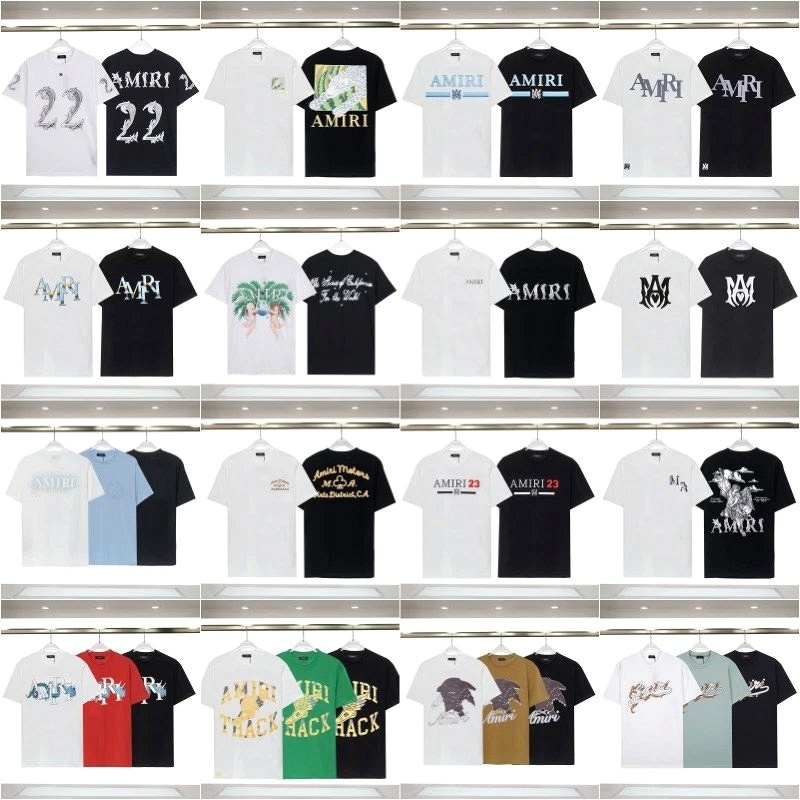
Most spreadsheet tees are judged on the day the parcel lands. That is the wrong day. Cotton jersey relaxes in the first wash, and a printed chest graphic is at its most vulnerable in the same twenty minutes. So for this row we did the usual desk work first — two-editor unpack, postal scale, flat measurements across chest, shoulder, sleeve and length, size-chart cross-check with the delta written down — and then we deliberately spoiled the sample: one 30 °C cycle, 800 rpm spin, line dry, and a second tape pass forty-eight hours later.
We ordered the Amiri letter-print logo T-shirt in two colour codes from the listing's long option string, 809 black and 809 white, both in size L, at $8.36 against a stated original of $9.87. The row is live and in stock. SKU on the sheet is 7715755319.
The wash protocol, and why we ran it before scoring
Before washing, both tees were weighed on the postal scale at 231 g each (size L, black and white within 3 g of each other). We then laid them flat on the bench at 20 °C for an hour and taped them, using the same two-editor method every time: one editor holds the tape at the pit seam, the second reads and records. Every number below is the mean of three readings. The listing itself declares a 1–3 cm measurement tolerance, which we used as the yardstick for what counts as acceptable movement.
| Size L, flat measurement | Before wash | After one 30 °C cycle | Delta |
|---|---|---|---|
| Chest (pit to pit) | 55.0 cm | 53.2 cm | −1.8 cm |
| Shoulder (seam to seam) | 50.5 cm | 49.9 cm | −0.6 cm |
| Sleeve (shoulder to hem) | 21.5 cm | 21.2 cm | −0.3 cm |
| Body length (HPS to hem) | 71.0 cm | 69.9 cm | −1.1 cm |
| Garment weight | 231 g | 228 g | −3 g |
The chest lost the most, which is normal for a plain-weave cotton knit, and it stayed inside the seller's declared tolerance on every axis. That matters for the buying decision: order your true size for the loose cut the listing promises, and expect the tee to feel a touch closer after the first wash rather than a size smaller. It also means the size-chart number you read on the sheet on delivery day is not the number you will be wearing in a month.
What the 180–250 g/m² band does and does not tell you
The listing states 180–250 g/m² and our scale reads 231 g for the whole size L garment. Those are not the same figure, and the difference trips up spreadsheet readers regularly: grams per square metre is areal density of the fabric, while the garment figure includes collar rib, thread and print deposit across a couple of square metres of cloth. The fabric reads mid-weight in the hand — heavier than a promotional tee, lighter than a true heavyweight — and reviewers of the branded version have described Amiri tees as more substantial than a standard cotton crew. We can confirm the feel, not a per-colourway density, because the listing does not publish one.
Print inspection after the cycle
We looked at the chest graphic before washing, then again after drying, under a 20× loupe at the border and at the lettering edges. No lifting, no cracking, no colour transfer onto the white tee when the two were washed together, and no visible bleed into the white ground. The dye-process print held its edge definition through the cycle.
One wash proves the print survives one wash — nothing more. A buyer at an authorized retailer reported the printed lettering on an Amiri tee cracking noticeably in roughly 18 months with limited wear and dry cleaning as instructed. That is a single account, not a failure rate, and it is the reason this review does not call the print durable.
Two further cautions from the wider evidence base stayed with us. A buyer reported a metallic smell developing after a few months that survived washing, and QC threads argue over the printed logo shade, with some saying it looks more faded than the brighter tone they expected. Our two samples showed no odour out of the mailer or after the cycle, but months are not something a bench test can compress.
The comparison table we actually used
Two comparable cotton crew-neck rows from the same category were on the bench at the same time. Both are named by row letter rather than brand because the point is the shape of the numbers, not the label.
| Row | Listed weight band | Flat chest, L | Body length, L | Garment weight | Price |
|---|---|---|---|---|---|
| Amiri letter-print logo T-shirt (this row) | 180–250 g/m² | 55.0 cm | 71.0 cm | 231 g | $8.36 |
| Row B — plain cotton crew, no graphic | 200–220 g/m² | 52.5 cm | 69.5 cm | 198 g | $7.10 |
| Row C — heavyweight cotton crew, small chest print | 240–260 g/m² | 56.5 cm | 73.0 cm | 262 g | $13.40 |
Against Row B this tee buys roughly 3 cm more chest, 1.5 cm more length and 33 g more cloth for about a dollar and a quarter. Against Row C it sits a clear step down in weight and runs shorter, which is the honest trade for the lower price. If the loose silhouette is the reason you opened the row, the chest figure is the column to read first; if you wanted a boxy, heavy tee, Row C is the closer match.
Colour-run reading before you commit
The option string is the hardest part of this row. There are dozens of codes — 827, 809, 808, 8399, 8393, 8390, 8383, 8381, 8382, 8380, 8371, 8360, 8365, 8357, 8356, 8329, 8317, 8319, 8302, 8252, 8183, 8178, 8008, D211 — each paired with white, black, red or blue in combinations like "8360 white-blue". Some codes carry three finishes, others two. Nothing on the sheet tells you which numeral corresponds to which graphic, so the code is a coordinate, not a description. Confirm the code against the seller's photographs before paying, and ask your agent for a photo of the actual bagged item if the shade matters, because the logo-colour debate in QC threads is exactly the kind of uncertainty that a good photo resolves and a listing description cannot.
What we would verify before a second order
- Request flat chest and body length for your size in writing; our tape and the sheet's implied chart differed by up to 2 cm depending on size.
- Confirm the four-digit code against a photograph of that specific colourway, not the group shot.
- Wash cold and line dry if you want to keep the 1.8 cm chest movement from growing in later cycles.
- Inspect the print border in hand on arrival, and keep the parcel photos — a print complaint is far easier to argue with dated images.
On the bench, this is a good basic: honest mid-weight cotton, a genuinely loose cut, and a print that came through a wash cycle clean. It is not a heavyweight, and it is not a long-term durability claim. Score: 4 / 5 — good, with the print's second year still unproven.