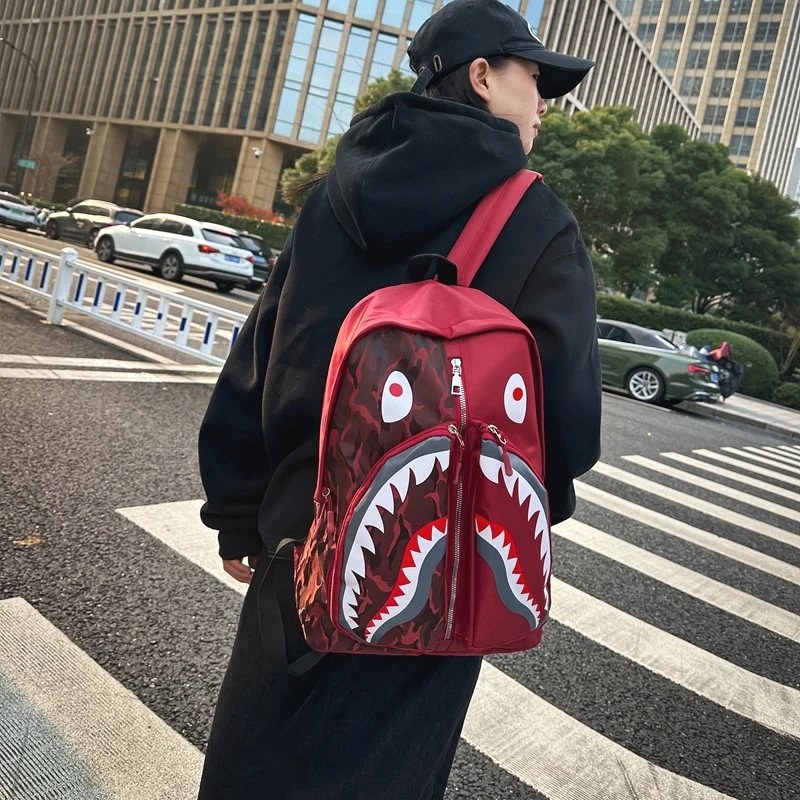
Most write-ups of this pack start with the print. We started with the pockets. The black colorway of the BAPE oxford backpack is a small-item bag pretending to be a daily carry, and whether it works comes down to three objects: a passport, a bifold wallet and a 6.7-inch phone. Two editors ordered one unit through an agent, opened the parcel on the bench, and spent an afternoon finding out which of those objects actually fits where.
Because a bag has no size chart, we adapted our usual cross-check. We took flat measurements by tape, weighed the parcel on the postal scale, calipered the hardware, and then held those readings against the listing's weight and compartment fields, recording every delta. Nothing was scored until step five.
The parcel, the scale and the flat tape
Our unit arrived in a poly bag inside a grey mailer, tags attached. On the postal scale it read 412 g with the bag and tags included. Laid flat and measured across the body, it came to 30.5 cm wide, 42 cm high and 13.5 cm deep. The webbing strap adjusts from a 44 cm to a 90 cm drop, and the top loop measures 9 cm across.
Calipers went on the metal and plastic: the zip puller measured 2.1 mm thick, the strap webbing 1.9 mm, and the adjuster buckle 3.2 mm at its widest point. None of that is premium hardware, but nothing felt sharp or unfinished.
The listing cross-check is where the record gets thin. No dimensions are published at all, so there is no official measurement to compare against ours — the delta is simply unrecorded. The weight field reads 0.00 kg against our 412 g, a difference of 0.412 kg that tells you the field was never filled in. And the compartment fields contradict each other: a count of 2 sits beside “no interlayer.” On our unit we found one main cavity, no divider, and two internal pockets — an open slip pocket and a zippered one. We read the “2” as the pockets, not as two separate bays, but that is our interpretation of a listing that does not say so.
The two-pocket load map
We loaded the pockets with objects rather than descriptions. The slip pocket is the useful one; the zippered pocket is the secure one; the main cavity absorbs everything else.
| Item | Size | Slip pocket | Zip pocket | Main cavity |
|---|---|---|---|---|
| Passport | 12.5 × 8.8 cm | Fits flat, about 1 cm spare at the top | Fits, but bends the corners | Not needed |
| Bifold wallet | 11 × 9.5 × 1.7 cm | Fits, snug at the mouth | Too bulky once keys are in | Fits upright |
| 6.7-inch phone | 16.1 × 7.6 cm | Does not fit flat | No | Fits, screen against the back wall |
| Keys and cardholder | Palm-sized | Fits | Fits with room to spare | Fits |
| 500 ml bottle | 7 cm diameter | No | No | Fits upright beside a paperback |
The practical result: passport and wallet can live in the slip pocket, the phone has to go in the main cavity, and the zip pocket is best kept for keys and cards. That is a sensible split for a commute or a short trip, but it means the “secret pocket” is not a phone pocket, and anyone hoping to keep a large handset off the main compartment will be disappointed.
Twenty minutes of one-handed access
We walked a 20-minute loop through the centre of Rotterdam with one editor wearing the pack and the other timing access. With both straps on, reaching the interior zip pocket meant slipping the right strap off the shoulder — nine to twelve seconds from stop to closed zip. Carried on one shoulder, the same reach took four to six seconds. The slip pocket was the quickest of all: three seconds, no strap movement.
The soft shell is the reason for the slower times. With nothing rigid inside, the bag collapses toward the opening when you reach in, so the second hand ends up steadying the body while the first works the zip. That is normal for an unstructured oxford-cloth pack at this price, and it is worth knowing before you plan to pay for a coffee without taking the bag off.
Two spreadsheet rows beside it
We placed the black unit against two comparable rows from our Kakobuy working sheet: a cheaper unbranded oxford daypack and the same BAPE bag in its red shark-face colorway. Only the reviewed pack was weighed and measured on the bench; the other two figures are listing claims.
| Row | Product | Price | Weight | Internal pockets | |
|---|---|---|---|---|---|
| 062 | Unbranded oxford daypack | $9.80 | 350 g listed | One zip pocket | None |
| 149 | BAPE red shark-face colorway | $14.45 | Not stated | Slip plus zip | Shark face |
| 7705013314 | BAPE black colorway, reviewed | $12.39 | 412 g measured | Slip plus zip | Front motif |
The black sits $2.59 above the unbranded row and $2.06 below the red at its original price. What the extra $2.59 buys is the second pocket and the print, not more capacity. What it does not buy is any published dimension, a padded sleeve, or a documented load rating. The red row costs more for the same pocket set and a louder graphic; the black is the quieter of the two and the easier one to wear with plain tops and wide trousers, which is the styling advice that circulates around BAPE shark-face packs.
What the score reflects
At 4 / 5, this is a good small-item bag for the money. The pocket split does real work, 412 g is light on a teenager's shoulders, and the 44–90 cm strap range covers a smaller frame without the bag sitting at the lower back.
The deduction is for the paperwork, not the stitching. A listing that says two compartments and no interlayer cannot be resolved from the page, and the missing weight field means you cannot compare shipping costs before ordering. Brand-level BAPE reviews are also split between praise and one-star complaints, and the one odor report we found concerns a garment, not this backpack — a caution about the brand's out-of-box consistency, not a finding about this unit. Confirm the cavity layout and dimensions with your agent, then judge the bag on the pockets.