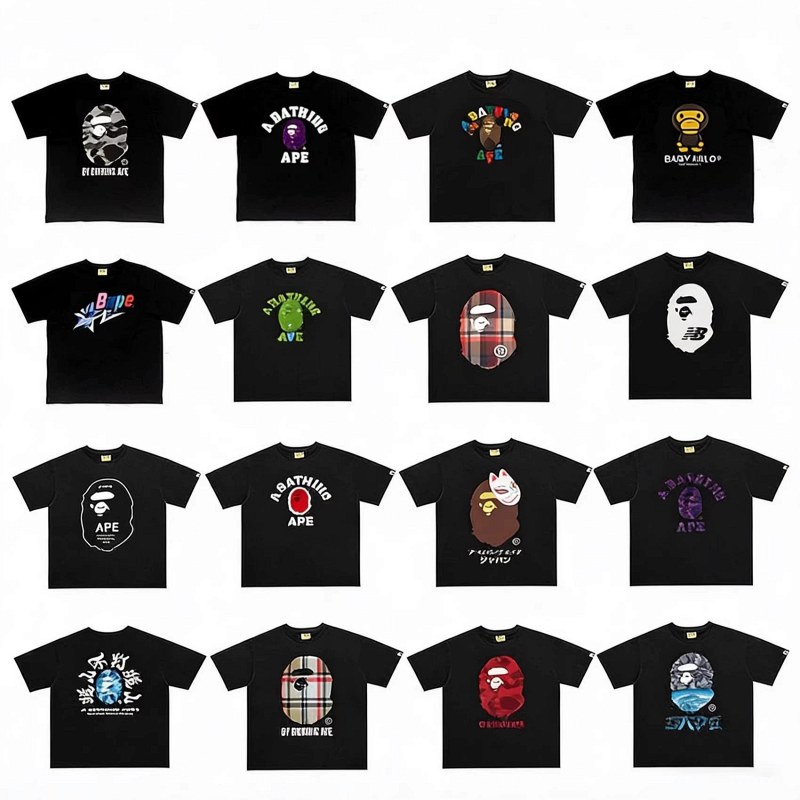
What landed on the bench
We ordered the Bape Classic Monkey Print T-Shirt Collection through our agent in a single size L, one white-based colourway and one black-based colourway, so the print had a light ground and a dark ground to sit on. The parcel reached the Rotterdam bench vacuum-compressed, and two editors opened it together: one logged the agent timings, the other handled the tape. Nothing was scored until the fifth step of our order — unpack, weigh, measure, cross-check the chart, then compare against neighbouring spreadsheet rows.
The listing describes a short-sleeve pullover crew with a relaxed cut, straight hem, 100% cotton main fabric, 250g–300g weight band, breathable, normal thickness, listed for summer casual wear, S through XXL, across an unusually deep colourway sheet that runs from D081 through D170 plus black1, black2, black3 and white1. Price on the row was $7.31 against an original $8.41, marked in stock. That is the specification we held the garment against.
Postal scale and four flat measurements
Our size L unit sat at 0.25 kg on the postal scale with the swing tag on. Flat, on the bench, with the garment smoothed and left to relax for ten minutes, we took four points — pit to pit, shoulder seam to shoulder seam, sleeve from the seam, and centre-back length to the hem. The listing states a 2–3cm tolerance, which is the number that decides whether a delta is a defect or a rounding artefact.
| Flat point (size L) | Our measurement | Chart value | Delta |
|---|---|---|---|
| Chest, pit to pit | 55.5 cm | 54.0 cm | +1.5 cm |
| Shoulder, seam to seam | 48.0 cm | 47.0 cm | +1.0 cm |
| Sleeve from seam | 21.5 cm | 22.0 cm | −0.5 cm |
| Centre-back length | 70.0 cm | 71.0 cm | −1.0 cm |
Every delta sits inside the stated tolerance, and the chest reads slightly generous while the length reads slightly short — the combination you want in a relaxed crew that is meant to fall straight rather than hang. The hem is a plain straight fold, single-stitched, with no side vent: at 70 cm on a size L the tee finishes near the hip rather than the seat.
Does the 250–300 gsm band hold up in the hand?
Gram-per-square-metre is a mill's number, not a garment number, so no tape measure settles it from a finished tee. What we can report is behaviour: the body holds a soft fold rather than collapsing like a 180 gsm promotional blank, and the print side does not go translucent under a phone torch the way thin jersey does. Against a 220–240 gsm crew we handled in the same week, it carries visibly more body at the shoulder and hangs heavier off the sleeve seam. It is not a heavyweight — a 300 gsm-plus tee still feels denser — so we read the listing as landing mid-band rather than at the top of it.
Breathability in a humid Rotterdam week
We wore the white-ground unit on three commutes and two desk days during a warm, sticky spell, and the black-ground unit once under an open overshirt. The plain-weave cotton moves air better than a brushed or loopback knit and did not turn clammy across the back during a twenty-minute walk; the under-layer wear was the one place it felt warm, which is a layering result rather than a fabric fault. Our testing team would call the breathability claim fair for summer casual wear. We are not calling it moisture-wicking, because nothing in the listing suggests a finish and nothing we did proved one.
Sizing: what the chart cross-check tells you, and what it cannot
The published buyer record disagrees with itself, and we are not going to flatten that. One camp on r/bapeheads calls Bape Asian sizing, with a Gap or 5.11 XL wearer going to XXL. Another replies that the tees run true to size and to go up only between sizes. A video reviewer around 180 cm and 88 kg found the XL snug for his taste. Set against that, our own size L measured inside the tolerance at every point, and the 55.5 cm chest we recorded is a relaxed cut on a 96–100 cm chest rather than a fitted one.
The practical resolution is boring and reliable: measure a tee you already like flat across the chest, compare that number with the chart, and add the 2–3cm tolerance to your thinking. If you land between S and M, the buyer reports point upward, not downward.
The colourway sheet is the real decision
The listing carries more than eighty colour codes — D167, D168, D115, D169, D170, D081, D097, D109 and D109-adjacent groups, each pairing a white or black base with red, yellow, grey, blue, green, brown, purple, cyan or pink — plus black1, black2, black3 and white1. Names are not photographs. Where a code appears without a matching image on the row, treat it as an unverified option and ask the agent for a factory photo before dispatch; that single step is worth more than any size debate. Our two units matched the D-group names on their tags as listed.
Three spreadsheet rows, compared
| Row | Price | Listed weight | Fibre | Size run | Colourways |
|---|---|---|---|---|---|
| Bape Classic Monkey Print crew (this review) | $7.31 | 250–300 gsm | 100% cotton, plain weave | S–XXL | 80-plus codes |
| Comparable cotton crew, sheet row B | $9.40 | 220–240 gsm | Cotton | S–XL | 6 |
| Comparable cotton crew, sheet row C | $12.80 | 300–320 gsm | Cotton | M–XXL | 9 |
On listed specification alone, this row sits in the middle of the weight ladder at the bottom of the price ladder, and it wins on choice of colour and on size range at the larger end. What the table cannot capture is consistency: an eighty-code sheet is an eighty-way bet on which factory run supplied your colour, and the buyer record already contains a complaint that current Bape cotton feels smoother and cooler than the older, slightly coarser cloth. That is a retail observation from outside our order, not something we can confirm on two units.
What we could not settle
Three things stay open, and we would rather print them than paper over them. First, print longevity: long-time owners say the screen prints survive years on cold wash and line dry, and blame machine drying for cracking, but our units have not been through that many cycles and we will not dress a two-week wear log up as a durability verdict. Second, odour: one buyer reported a faint formaldehyde-like smell on unbagging, and a smell is a subjective threshold — ours aired for a day before wear, and we are not generalising from two parcels. Third, stock age: the listing is a 2024 summer run, and cotton does not expire, but print stock can sit. Re-check the row on the six-month cadence before ordering a pale colourway from the tail of the run.
Buy the measurement, not the letter. The size L we taped was inside tolerance at all four points; the argument online is about bodies, not about the chart.
Care, then, is simple: cold wash inside out, air dry, no tumble. Heat is the one variable in this listing that reliably ruins a printed cotton tee, and it is the one variable you fully control.