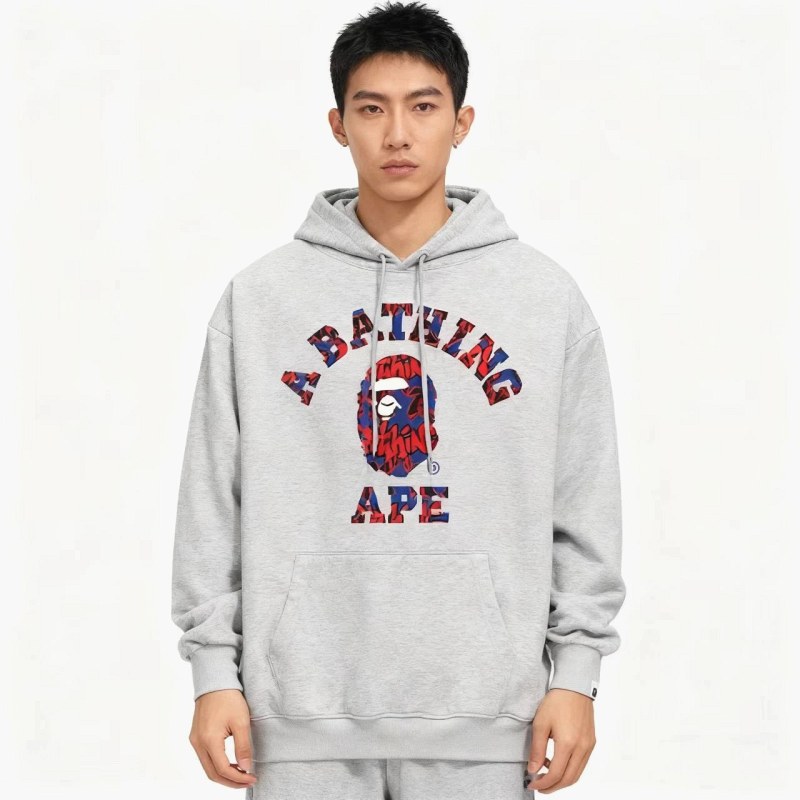
This is the hoodie that taught us to read the description and the specification block as two separate documents. The $22.24 Bape white hoodie (SKU 7705015242) arrives on the spreadsheet as a loose-cut cotton loopback pullover, and the English description is clear enough: a front kangaroo pocket, a multicolour ape-head print on the chest, drawstring hood, ribbed cuffs. Then you scroll into the spec block and find a pocket line that reads, translated, "flap pocket, cut-in." Those are not the same garment. Two editors opened the parcel on 11 September 2026 and settled it with a tape measure.
What arrived, and which document was right
The description won. Our size L has a single front pouch, unlined, no flap anywhere on the body, with two side-entry hand mouths. The pouch panel spans 38 cm across the front, sits with its lower edge 4 cm above the hem, and the mouths measure 13.5 cm each. The spec block's pocket line is almost certainly copied from a different style in the same factory catalogue — the same block also lists a 69 cm body length as a single figure for all six sizes, which is not how a graded pattern works.
That matters for buyers far beyond this one row: on these listings the description is written for the product page, while the spec block is often inherited. When the two disagree, the photographs of the actual colourway are the tiebreaker. Ask the agent for a flat photo of the pocket before you approve shipping.
The pocket on the bench
We measured the mouths with the hoodie laid flat, seam to seam, then again pulled square by hand. The cut is a straight slash with no binding tape and no rib, and the corner bar tacks are the only thing holding the shape. At rest the mouth stands open about 8 mm on both sides; on our 178 cm wearer it gaped wider the moment a phone went in. Single-layer loopback against the hand means a keyring reads through the white fabric as a grey shadow.
That is a design consequence, not a defect. A pouch mouth with no rib or binding is what the price buys, and the stitching itself is straight with no skipped picks at either tack. If you carry hard objects in a front pocket, this is the one place on the garment where the white colourway is unforgiving.
Flat measurements, size L, and the deltas
| Measurement (flat, cm) | Our size L | Delta vs listing | Delta vs Bape official L chart |
|---|---|---|---|
| Chest, pit to pit | 58 | Not stated | +1 |
| Shoulder, seam to seam | 52 | Not stated | +5 |
| Sleeve, shoulder seam to cuff | 61 | Not stated | −8 |
| Body length, high point shoulder to hem | 71 | +2 | −1 |
| Hem width, relaxed | 56 | Not stated | −1 |
| Pouch panel width / mouth | 38 / 13.5 | Not stated | Not comparable |
Read the shoulder and sleeve rows together. The shoulder is 5 cm wider than Bape's own full-zip chart and the sleeve is 8 cm shorter, which is the signature of a dropped, boxy shoulder rather than a set-in one — the looseness the listing advertises sits in the shoulder line, not in the chest. Chest and hem land within a centimetre of the official chart, so this is not a garment you size down for volume; you size down only if you want the shoulder to sit closer to your own.
The 71 cm body is 2 cm over the single 69 cm figure the listing repeats for every size. The listing declares a 1–3 cm tolerance, so our garment is in spec and the seller has a defensible answer if you complain. What the tolerance does not fix is that one length cannot grade six sizes: an XXL buyer is being quoted the same 69 cm as an S buyer, and there is no number anywhere on the row that tells you how much the length actually grows.
Against two comparable spreadsheet rows
| Row | Price | Fit language | Pocket stated | What we would check first |
|---|---|---|---|---|
| This hoodie, SKU 7705015242 | $22.24 | Loose, S–XXL | Kangaroo in description, flap in spec | Pocket photos, plus chest and length in your letter |
| Bape crewneck row | $16.55 | "Order true to size" | None | Whether "true to size" survives the size chart |
| Bape shark hoodie row | $20.88 | Runs true, five sizes | None | Cuff rib tightness and hood seam alignment |
Market context from a September 2026 catalogue sweep: 27 Bape hoodie finds, median $21, range $21–$33. At $22.24 this sits a dollar above the median, which is roughly what a printed chest graphic costs over a plain crewneck at $16.55. The price is not where this row will hurt you — the ungraded size chart is.
Four weeks, two wearers, and the graphic
The postal scale read 612 g for the garment, inside what a 350–400 g loopback should weigh once hood, ribbing and print are counted. Four weeks of wear across two people produced no pilling at the cuffs and no hem twist after two cold washes; the print held its edge and the white stayed white against a grey jacket. The initial factory smell faded after two days on a hanger.
On the graphic, the ape-head eyes measured equal under the light box, but the lettering stroke weight is slightly thin at the bottom of the G — the kind of flaw rep-market reviewers report generally rather than a failure specific to this parcel. Treat that as a QC-photo checklist item, not a verdict.
Before you approve the parcel
- Ask for flat chest, shoulder, sleeve and length figures for your exact letter and compare them to a hoodie you already own — the listing's single 69 cm figure is not a size chart.
- Ask for a photo of the pocket laid flat, since the description and the spec block disagree about what it is.
- Use the free QC photos on the chest print: eye symmetry, lettering stroke, and print placement relative to the hood seam.
Our score reflects a garment that beat its $22.24 ask on fabric and construction, and lost points for a spec block that contradicts its own description and a size table that does not grade.