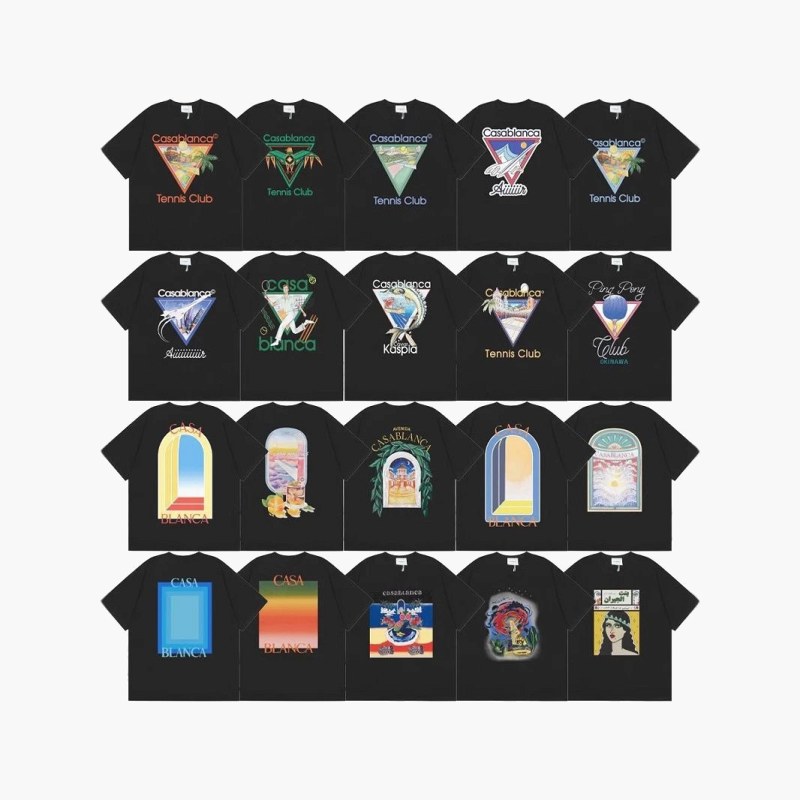
Our sheet lists this one under Casablanca, SKU 7718753246, at $8.81 against a struck-through $9.27, marked in stock. The row describes a pure cotton pullover with a collarless crewneck, short sleeves, a loose cut, a print-dye graphic, normal thickness, no hood, and a stated 1–3 cm measurement tolerance across S–XL. We ordered black, had it sent through our agent, and opened the parcel on the bench in front of two editors before anything was written down.
What follows is the bench file: what the scale said, what the tape said, where the chart and the shirt disagreed, and which parts of this listing a buyer can actually rely on.
Unpack and the postal scale
The listing row carries no usable shipping weight — it shows 0.00, which means unrecorded, not featherweight. Our postal scale settled it: the shirt alone came in at 0.21 kg, and 0.26 kg with the mailer and the folded poly bag. For a tee listed at 250 g cotton in a size L, that is where we expected it to land.
In the hand, the jersey is soft and slightly dry rather than slick. There is no rubbery film sitting on the print — the graphic reads as though the dye went into the fibre rather than on top of it. Seams are single-stitched and flat. The collar is a plain ribbed band with no separate collar piece, matching the collarless description.
Flat measurements against the chart
We taped the shirt flat on the bench, unwashed, and took every figure twice. Sizes S–XL only, so the L is what we could compare directly; the rest of the table is the listing's own chart, which we cross-checked for internal consistency rather than taping every size.
| Measure (flat, cm) | Chart, L | Our L | Delta |
|---|---|---|---|
| Chest, pit to pit | 57 | 56.5 | −0.5 |
| Body length, HPS to hem | 72 | 72.5 | +0.5 |
| Sleeve, collar edge to cuff | — | 33 | n/a |
| Hem width | 57 | 57 | 0 |
| Shoulder, point to point | 48 | not applicable | — |
Both deltas sit inside the stated 1–3 cm tolerance, so the chart is honest on the numbers it prints. The catch is the shoulder row. This shirt has a raglan sleeve — the seam runs from the underarm to the collar — so there is no shoulder seam to measure point to point, and the 48 cm figure on the chart cannot be checked against the garment in the usual way. If you are used to comparing shoulder widths across your wardrobe, that one row is decoration. Judge this tee on chest and length.
The raglan seam, and why this layers
Our first assumption was that a raglan cut on a cheap tee would mean a sloppy sleeve head. It did not. The seam sits low and flat against the shoulder, there is no gathered fabric at the crown, and the sleeve follows the arm instead of catching when you reach forward. Worn under an open overshirt for a full afternoon, the shoulder did not bunch or push the outer layer up.
The trade-off is visual: the diagonal seam changes the line of the shoulder, and it makes the shirt read a little softer and wider than a set-in sleeve of the same chest width. That suits the loose-cut streetwear brief. It will not suit anyone hunting a sharp, tailored shoulder line.
Print, collar and four cold washes
The graphic panel is busy at close range — geometric shapes layered into a cartoon motif — and the registration held when we checked it against the daylight lamp. Edges are clean, with no haloing into the black ground.
We washed it four times on a cold cycle, inside out, and air-dried it flat each time. After the fourth pass the print edges had not lifted, cracked or dulled, and the hem stayed level. The collar relaxed by roughly 4 mm across the neck opening and did not ripple. That is a good result for a sub-$10 tee; it is a four-wash result, not a season-long one, and we will re-check it at the six-month pass.
The variant menu is the actual risk
The colour list runs from code 90 down to 37, each in black and white. A number is not a colour name and it is not a description of the artwork. Two buyers can order "black" here and receive shirts with entirely different graphics on the front.
We opened the product photographs for our code and confirmed the artwork matched what arrived. That is the whole procedure: find your code in the image set, look at the picture, and only then pay. If a code has no photograph, treat it as a question for the seller before dispatch.
Against two rows on the same shelf
| Row | Price | Claimed build | What moved us |
|---|---|---|---|
| This Casablanca tee, SKU 7718753246 | $8.81 | Pure cotton, 250 g, loose, raglan short sleeve | Chart matched within tolerance; raglan shoulder layers cleanly |
| Casablanca silk-shirt row on our sheet | about $27 | Printed silk blend, boxy cut | Different garment entirely; the tee is the easier first order |
| Plain 180 g cotton tee row | about $5.40 | Combed cotton, set-in sleeve | Cheaper and cooler, but no graphic and a thinner hand |
Set against the plain blank, the extra $3.40 buys the print, the raglan construction and a noticeably denser jersey. Set against the silk row, it is a different product for a different job — we would not treat the price gap as a quality signal in either direction.
Where the evidence runs out
Two things stay open. First, sizing. Buyer threads on Casablanca tops split between slightly oversized and true to size, with at least one recommending sizing down for a tailored fit. None of that addresses this listing, so the tape and the chart are all you have; our L behaved loose and matched its numbers.
Second, after-sales. One retail buyer reports a defect after minimal wear and a refused replacement. It is a single report about the brand generally, not a pattern, and it does not describe this SKU. We note it because a $8.81 tee has no meaningful repair path, and a buyer who wants documented support should ask for the policy in writing before paying.
What we can say plainly: the shirt on our bench is a mid-weight, correctly measured, well-printed cotton crewneck that survives a normal wash cycle. The listing around it is vague in exactly the places that matter — artwork per code, shipping weight, and which fit story applies.