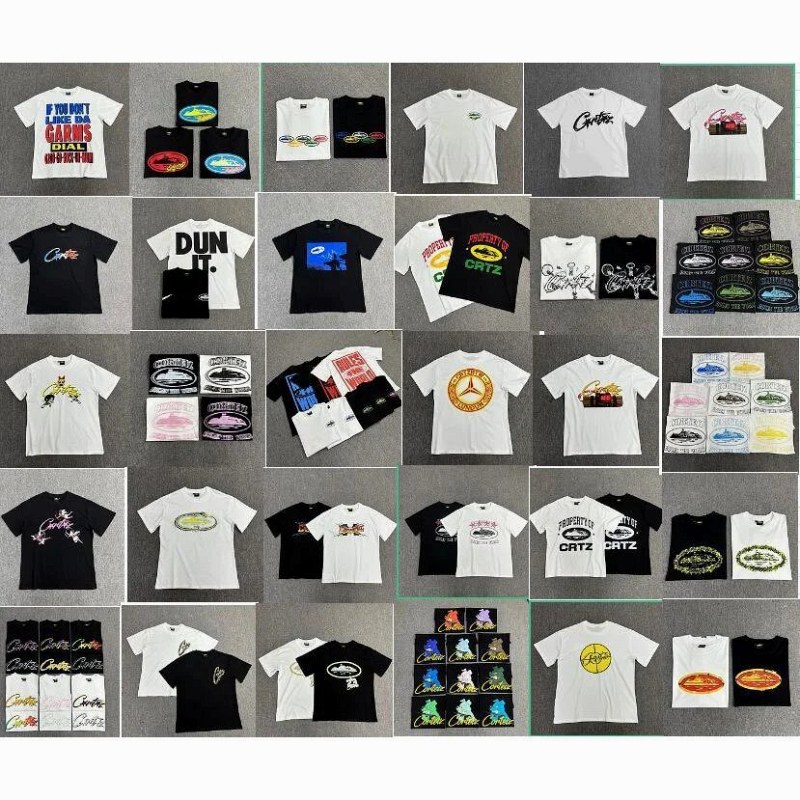
What we ordered and how it landed
The row is one product: SKU 7718770988, a polyester crew-neck tee listed at $4.93 against a struck-through $5.91, in stock, sizes S through 3XL, and 51 colour codes built on 16 numeric prefixes (3156, 3155, 3153, 3152, 3122, 3121, 3118, 3116, 3115, 3113, 3112, 3106, 3105, 3103, 3102, 3109). The description promises a loose fit, a classic crew neck, short sleeves, 3D-effect lettering, breathable polyester at a 180–250 g weight, and a stated 2–4 cm sizing tolerance.
Two editors opened the parcel together on the Rotterdam bench. We ordered two units — 3156 black in S and 3156 white in 2XL — because a single size tells you nothing about whether a chart is scaled honestly. Both arrived folded print-side inward, each in its own poly bag, no hanger, no tissue, no size sticker on the bag itself; sizes were only readable from the printed neck label and the woven care tag. The gallery we worked from carries 40 images for 51 codes, so roughly one in five variants is not pictured at all. That is the first thing to know before you pick a code off a list.
The postal scale result
We weigh garments before we measure them, because gram weight is the cheapest available proxy for how a knit will behave after ten washes. The listing claims 180–250 g. Here is what our bench scale read.
| Item | Bench weight | Notes |
|---|---|---|
| 3156 black, size S | 196 g | First pull from the bag |
| 3156 white, size 2XL | 203 g | 7 g heavier than the S |
| Outer mailer (empty) | 38 g | Grey poly, single seal |
| Full parcel of two | 437 g | Matches 196 + 203 + 38 |
Both garments sit inside the claimed band, comfortably above the 180 g floor and nowhere near the 250 g ceiling. Two things follow from that. First, the weight claim is honest — worth saying, because it is the one specification on this row we could falsify cheaply and it held. Second, the seven-gram spread between an S and a 2XL is small, which suggests the fabric is the same throughout the run rather than getting heavier as sizes climb, as some factories do to keep large sizes opaque.
The 2XL was also noticeably more see-through against the window light in white than the black S — unsurprising for a 200 g polyester jersey, and a reason to treat the white and pale-blue codes as layering pieces rather than standalone summer wear.
Flat measurements against the listing's own chart
We measured chest pit-to-pit, shoulder seam-to-seam, sleeve from shoulder seam to cuff, and length from high point shoulder to hem, all flat and unwashed, then cross-checked against the chart on the page.
| Measurement | S — ours | S — chart | Delta | 2XL — ours | 2XL — chart | Delta |
|---|---|---|---|---|---|---|
| Chest, pit to pit | 51 cm | 54 cm | −3 cm | 62 cm | 65 cm | −3 cm |
| Shoulder | 46 cm | 48 cm | −2 cm | 56 cm | 58 cm | −2 cm |
| Sleeve | 21.5 cm | 23 cm | −1.5 cm | 25 cm | 27 cm | −2 cm |
| Length | 65 cm | 68 cm | −3 cm | 74 cm | 77 cm | −3 cm |
Every delta runs negative, and every delta sits inside the stated 2–4 cm error range, with the largest at 3 cm. Read that carefully: the garment is not contradicting its chart, it is sitting at the small end of the tolerance the listing already disclosed. If you want the fit the chart describes, take the measurement you want and add 2–3 cm of shopping margin, because the delivered tee will probably land near the lower edge.
Proportionally, the shape matches the reported brand cut: wide through the chest relative to length, hem finishing higher than a standard tee, and a sleeve that ends past the halfway point of the upper arm on our 178 cm and 165 cm testers. On the S the sleeve measured 21.5 cm — enough to sit well below mid-bicep without reaching the elbow.
Cost per gram, against two neighbouring rows
Per-gram maths is not a quality score. It is a sanity check on whether a cheap price is cheap because the garment is light, or cheap despite being substantial. We ran this row against two comparable T-shirt rows from the same spreadsheet pass, both ordered in a size L.
| Row | Price (USD) | Flat weight | Cost per gram | Fabric | Top size |
|---|---|---|---|---|---|
| This row (SKU 7718770988) | $4.93 | 196 g (S, black) | $0.025 | Polyester, 180–250 g claimed | 3XL |
| Neighbour A — plain crew tee | $6.20 | 184 g (L) | $0.034 | Cotton jersey | 2XL |
| Neighbour B — heavyweight tee | $9.10 | 236 g (L) | $0.039 | Heavyweight cotton | XL |
At about 2.5 cents per gram this row is the cheapest of the three, and it is also the only one of the three that reaches 3XL. Neighbour B is the better-built garment on the hand-feel test and costs 56% more per gram for it. Prices move; these were captured at order time and should be re-read before checkout.
Where the per-gram figure stops being useful
Polyester is the cheapest fibre in the chain, so a low price per gram is partly a material story rather than a manufacturing triumph. The 3D-effect lettering is a print, not an appliqué or an embroidery; on our two units the panel measured 24 × 17 cm on the front, the edges were clean but flat, and the "3D" reading comes from shading in the artwork rather than any raised surface. The stitching is serviceable — single-needle hems, a 1 cm seam allowance, ribbed collar with a taped back neck — and nothing on either tee was loose out of the bag.
Buyer sentiment on the brand's tees is genuinely split, and we are not going to smooth that over.
"Half the time it's unnecessarily expensive and the quality of the t-shirts isn't that good… T shirt quality is shit, other items are pretty good." — buyer comment collected on a Corteiz legit-check guide
Against that, long-term customers rate the brand's store around 4.6/5 across hundreds of reviews, with recurring praise for longevity. Both can be true: a $4.93 spreadsheet tee is not a $70 retail tee, and the complaint above is about the retail price, not this one. Our units raised no defect after a 30-degree wash, though two washes is not a durability verdict — our six-month re-check will carry that question.
Fit, sizing and the 2–4 cm clause
Published fit guidance for Corteiz tees does not agree with itself. Reseller listings commonly say true to size; some size guides advise going one down for a structured fit; others say the tees run small. The most useful buyer report we found sits in the middle:
"I have three t shirts from corteiz and they fit true to size. If u want them baggy I would say go a size up." — r/corteiz thread on T-shirt sizing
That describes the brand's tees generally, not this listing. Combined with our own −3 cm deltas, the practical rule is: order your normal size if you want the loose-but-cropped shape the photos show, and use the chart numbers plus a 2–3 cm allowance rather than the size letter alone. Customers above 3XL have no option here at all.
What we would still confirm before ordering
- The exact code. Ask the agent for a photo of your chosen code, since the gallery covers 40 of 51 variants. Prefixes behave differently: 3153 offers yellow-print, red-print and red-print variants that read quite differently on a white base.
- The colour name versus the image. Several codes carry print descriptors (black-red, black-blue, rainbow) where the base colour is not the headline — read the code, not the colour word.
- Availability at your size. The row is in stock, but codes sell out unevenly; confirm before you build a haul around one.
- Weight of your specific size. Our 196 g and 203 g figures cover S and 2XL only. A 3XL may sit higher in the 180–250 g band.