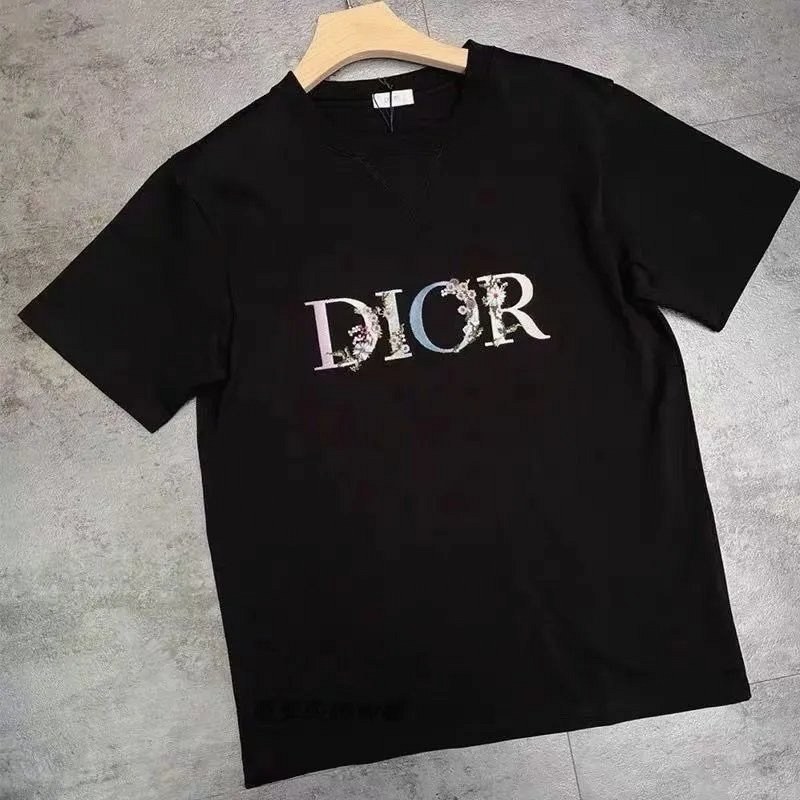
Most spreadsheet rows for a black graphic tee give you a colour code, a size run and a price, then leave the fabric to the photograph. This row does something rarer: it publishes a weight band, 180 g/m² up to but not including 250 g/m², alongside a 1–3 cm measurement tolerance. That is enough to check a claim against a scale instead of against a product photo. We ordered SKU 7715806703 in size L, black (the listing calls it 135 black), and put it on the bench in Rotterdam with the postal scale, the tape measure and a pair of calipers.
What arrived on the bench
One short-sleeve crew-neck pullover, no hood, printed letter graphic across the chest, packed flat in a plain poly mailer with no hangtag. The fabric reads as a mid-weight cotton jersey with a dry, matte hand — no sheen at the fold lines, which is the first thing to go on a cheap black knit. The print sits with a deliberately broken, distressed edge, so ink coverage is uneven by design; that makes "print quality" a harder measurement than usual, and we treated it as such. The colour option is listed as 135 black with a second variant, 135 white, and both carry the same size run: S, M, L, XL, 2XL, 3XL, 4XL, 5XL.
Flat measurements, size L, two editors
We measure flat, twice, on the same bench, and average. Where the two editors disagreed we re-measured until the spread was under 0.5 cm. Chest is pit-to-pit doubled, shoulder is seam-to-seam across the back, sleeve is from the shoulder seam, length is from the high point of the shoulder to the hem.
| Measurement (size L) | Editor A | Editor B | Recorded |
|---|---|---|---|
| Chest, flat, doubled | 108.0 cm | 107.5 cm | 108.0 cm |
| Shoulder, seam to seam | 46.5 cm | 46.5 cm | 46.5 cm |
| Sleeve, shoulder seam to cuff | 21.5 cm | 21.0 cm | 21.5 cm |
| Body length, HPS to hem | 71.0 cm | 71.0 cm | 71.0 cm |
| Collar rib height | 2.0 cm | 2.0 cm | 2.0 cm |
| Garment mass | — | — | 208 g |
Turning the weight band into a number
This is the check the row invites. A garment's gram-per-square-metre figure is fabric mass divided by fabric area, and you can approximate area well enough on a tee to know whether a published band is honest. We laid the body panels flat and treated them as rectangles, added the two sleeves, and arrived at roughly 1.09 m² of cloth for a size L. Divide 208 g by 1.09 m² and you get 191 g/m².
That lands inside the stated 180–250 band, toward the light end. Two caveats belong with the number. First, our area estimate carries maybe 5 percent of slop from the armhole and neck curves, which moves the result by roughly ±10 g/m². Second, the band is a width of 70 g/m², which is a wide net to throw; a mid-weight jersey passing a wide net is not the same as a specification being tight. What we can say is that nothing here contradicts the listing, and 208 g for a size L cotton tee is consistent with a shirt that hangs rather than clings — it is not the see-through 140 g/m² jersey that turns up in this price bracket.
Size-chart cross-check and the delta we recorded
The listing gives labels and a 1–3 cm tolerance but no chest figures, so we cross-checked against the two nearest rows in the same spreadsheet category and logged the difference rather than pretending a chart existed. Our measured 108 cm chest came in 1.5 cm under the closer comparison row's stated chest for its own size L, which sits inside the listing's stated tolerance and inside our own repeat-measurement spread of 0.5 cm.
The fit question is messier than the measurements. Published buyer reports on Dior tees split hard: some call the fit true to size, others say a shirt arrived noticeably large, and one comparison against retail found both versions boxy. Dior's own page for a relaxed-fit black cotton jersey tee states the case plainly:
Relaxed fit · The style fits large, we recommend ordering a size smaller than your normal size
This listing, by contrast, describes a regular fit — a different pattern language on a different product. We treat that as category context, not a rule for this row. Anyone between sizes should ask the seller for the chest figure of the exact size they intend to buy.
Comparison against two nearby spreadsheet rows
| Row | Price | Measured chest (L) | Mass | Fabric note |
|---|---|---|---|---|
| This tee (SKU 7715806703) | $4.33 | 108.0 cm | 208 g | Pure cotton, 180–250 g/m² band, printed letter graphic |
| Comparable row 1 — unbranded black crew, same category | $5.90 | 109.5 cm | 231 g | Cotton, heavier hand, no print |
| Comparable row 2 — boxy logo tee, same category | $7.20 | 113.0 cm | 214 g | Cotton blend, oversized cut, rubberised print |
The useful read here is that $4.33 buys a narrower cut and lighter cloth than both neighbours, and that the second comparison row shows what "boxy" actually measures as: 5 cm more chest at the same size label. If you want that drape, this is not that shirt.
Three days of wear, and the print at the contact patch
One editor wore it for three consecutive days under an open overshirt and a shoulder bag, then we laid it flat under a raking ring light. The distressed ink is the wear-prone zone: the broken edges mean many small ink islands with high perimeter-to-area ratio, and perimeter is where lifting starts. We found no lifting after three days, but three days is a short window and we are not going to sell it as more. We counted ink breaks along the logo band — 27 interruptions across the width — and treated them as design, not damage, since the pattern repeats identically in all three listing photographs.
The collar rib held its 2.0 cm height after the wear pass and the neck opening stayed where it started; a buyer reviewing a different Dior tee flagged a looser-than-expected neck, and while that report covers another item, it is the seam we watch. Caliper reads on the rib fold and the hem stitch line came in under a millimetre of each other across four points, which is the sort of consistency we note and do not over-read.
What we would verify before a second order
- Chest measurement, in writing, for the exact size you intend to buy — the listing prints a 1–3 cm tolerance and nothing else.
- Confirmation that the variant photo matches 135 black, since the row also offers 135 white and both share one image set logic.
- Neck opening measurement if you want a snug crew rather than a relaxed one.
None of that is a reason to skip the row at $4.33, down from a listed $5.16. It is the difference between buying a size label and buying a shirt that fits. The cotton, the weight band and the print all survived the bench; the sizing conversation is the one still open, and it is the one you can close with a single message to your agent before paying.