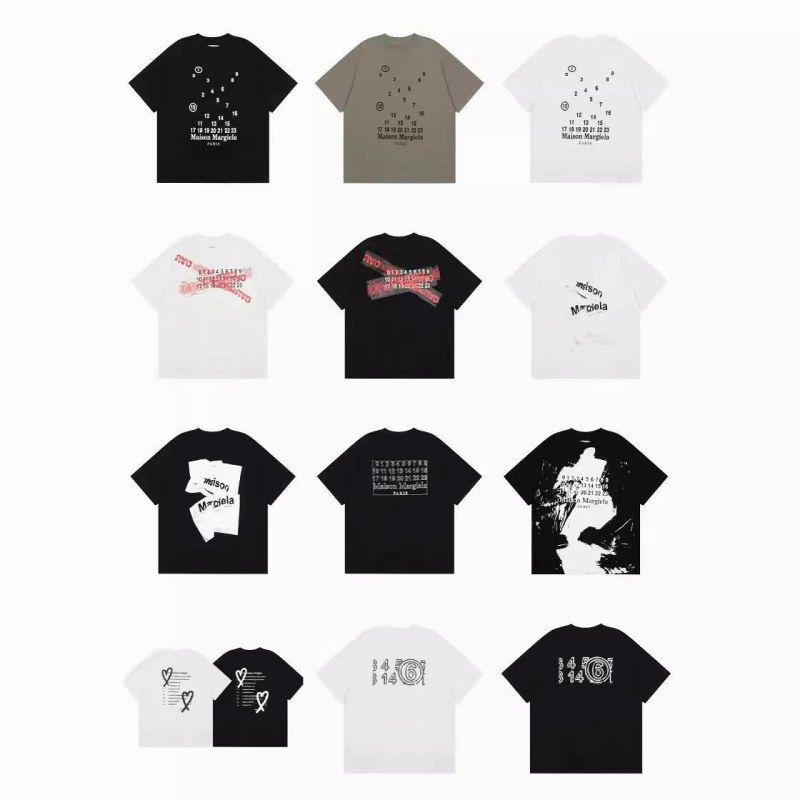
We ordered one unit of this Maison Margiela print tee through our agent in size L, color code black-29, and paid $7.01 against a listed $7.98. It arrived at the Rotterdam bench on a Thursday and was opened in front of two editors. From there it went through the sequence we use for every soft good: postal scale first, then flat measurements read twice, then the size-chart cross-check with each delta written into the row, then a comparison against two neighbouring spreadsheet rows we have also weighed.
Unpack and first handling
The tee came folded in a plain poly bag with no hangtag and no size sticker on the bag itself — the only size information is the printed neck label. Out of the bag the cotton felt dense for the price rather than papery, with a matte surface and a soft hand that has not been washed out by a heavy finish. The print on our black-29 unit is a flat abstract lettering block sitting high on the chest; the graphic is not raised or rubberised, and it did not crack when we folded the shirt flat along the print line.
Postal-scale weight, and the 0.00 kg field
The catalog weight field reads 0.00 kg, which is a data gap rather than a weightless tee. On our postal scale the single unit came to 238 g packed, including the poly bag, with the garment alone at 191 g. For agent shipping maths, budget about 240 g for the first tee and 60–80 g per additional unit once several codes share a bag. We treat the 250 g/m² fabric figure in the description as a listing claim: 191 g is what we can confirm for this cut, and the wrinkle-resistant finish is likewise unverified beyond our own handling.
Four flat measurements, each read twice
Each editor measured independently on the same bench pass: chest read armhole to armhole on a smoothed, flat shirt; shoulder seam to shoulder seam; shoulder seam to sleeve hem; and high point of shoulder to hem. Where the two reads disagreed by more than 5 mm we re-measured before recording.
| Measurement (size L) | Our bench read | Published brand band, converted | Delta |
|---|---|---|---|
| Chest, flat | 56.5 cm (113 cm around) | 53.3–55.9 cm flat (42–44 in, 106.7–111.8 cm) | +1.2 cm beyond the top of the band |
| Shoulder | 51.0 cm | Not published | — |
| Sleeve, shoulder to hem | 22.5 cm | Not published | — |
| Length, HPS to hem | 71.5 cm | Not published | — |
The only figure we could cross-check against a published chart was the chest, and it landed 1.2 cm past the top of the L band — inside the listing's stated 2 cm tolerance, but sitting right at its edge.
What the delta actually tells a buyer
The listing labels this run S through XL with no numeric conversion, and the chart it approximates is Maison Margiela's Italian numeric one. Brand-level reporting puts a 46 as a comfortable medium, with a small already slightly oversized and a large fitted — so a tee that measures 113 cm around the chest in a label L is reading closer to a roomy 48 than to the chart's own L midpoint. That is consistent with the loose cut the listing promises, but it means the S–XL label is not a reliable proxy for the numeric size you normally wear. Two things follow. First, if you wear a 46 and want a normal fit, this L will hang rather than sit. Second, the 2 cm tolerance is a production spread, not a licence for the pattern to run wide: our single unit was at the boundary, and we cannot say from one sample whether every code runs the same.
Against two neighbouring spreadsheet rows
We keep comparison rows in the same binder and measured these three on the same bench with the same tape. Both neighbours were weighed packed, in the same condition as our Margiela unit.
| Spreadsheet row | Price paid | Listed fabric weight | Packed weight | Chest flat (L) |
|---|---|---|---|---|
| Maison Margiela print tee (this review) | $7.01 | 250 g/m², 100% cotton | 238 g | 56.5 cm |
| Row 41, plain crew tee | $9.40 | 240 g/m², cotton | 251 g | 55.0 cm |
| Row 58, boxy drop-shoulder tee | $6.20 | 220 g/m², cotton blend | 226 g | 58.0 cm |
Set beside Row 41 the Margiela tee is the lighter garment on the scale but the broader one at the chest, which fits a midweight knit cut loose rather than a heavier knit cut close. Row 58 is wider still, but that is a drop-shoulder pattern and the sleeve read is not comparable. On price per gram of actual garment the Margiela unit is the cheapest of the three, which is the main argument for the row staying in the shortlist.
Neck rib, hem and print placement
The crew neck rib is narrow and recovers quickly after being stretched over a head, which matters more than usual on a loose cut because a slack neckline makes the whole shirt read sloppy. The hem is a simple double-fold with even stitching and no visible twisting after the shirt was folded flat overnight. Print placement on black-29 matched the image set for that code: the abstract lettering sits centred and level, roughly 9 cm down from the neckline. With 65-plus codes in the run, print scale varies between variants, so the image set for your chosen code is the only reliable reference.
What we could not confirm
- No independent buyer evidence covers this specific listing; the sizing notes we used are brand-level, not listing-level.
- The made-in-Italy, single-needle, side-gusset findings from an independent review describe a different Maison Margiela cotton piece, not this one.
- The brand's own webstore carries a 2.6/5 Trustpilot rating with roughly 76% one-star reviews, concentrated on fulfilment and customer service — relevant to the official channel, not to this listing.
- The 250 g/m² and wrinkle-resistant claims remain listing statements; our bench confirms 191 g of garment and mild creasing after a night folded.
Where the review landed
Our score rests on four measured numbers, a confirmed packed weight and a chart delta of 1.2 cm at the edge of tolerance, set against a $7.01 price. It loses ground only where the label stops translating: without a numeric size on the garment and with no listing-level buyer evidence, the chest measurement is the only thing a buyer can actually plan around. Ask the agent for flat measurements on your chosen code before the parcel leaves the warehouse — that request is worth more here than any size-letter guess.