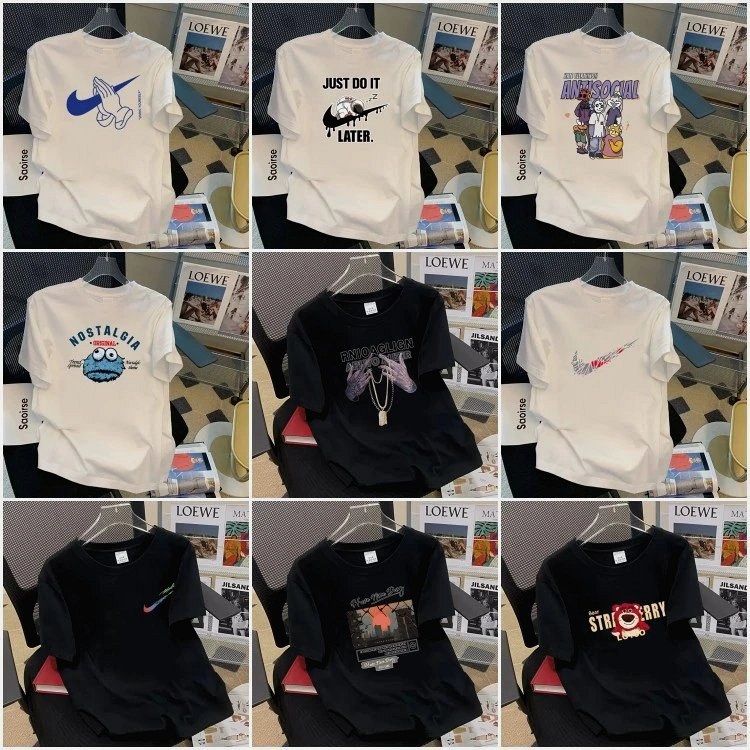
Item 7715836021 arrives on the spreadsheet as a single row: Nike, $3.88, down from $4.49, sizes L to 5XL, thirty print-and-colour combinations, and a catalog weight of 0.00 kg. The description then does something we see often and never enjoy — it gives the same garment two different fibers. Main fabric component: acrylic. Fabric name: polyester. Both readings sit in the same paragraph, and neither is flagged as a blend.
We bought two units through our agent, one in L and one in XL, in the black short-sleeve build, and put them through the standard desk sequence: unpack in front of two editors, postal scale, tape measure, size-chart cross-check, then the comparison table against two other rows in our sheet. Nothing was scored before those steps were done.
What arrived, and what the parcel weighed
The two units landed in a single polymailer. Garment-only weights on our postal scale: 172 g for the L and 186 g for the XL. The listing states a 180 g to under-250 g band, so the XL sits inside it and the L sits just under the floor. The mailer plus both units came to 0.44 kg, which is the number that actually matters when you are deciding whether a $3.88 filler justifies its share of a consolidation.
The 0.00 kg catalog weight is a placeholder, not a measurement. Treat any row that reports zero as unknown and ask the agent for a scale photo before you build a shipping plan around it.
Flat measurements against the listed chart
Garments laid flat, single layer, wrinkles smoothed by hand, tape pulled snug but not tight. Chest is pit-to-pit across the front, doubled for circumference.
| Size | Chest (flat, doubled) | Shoulder | Sleeve | Length | Delta vs chart chest |
|---|---|---|---|---|---|
| L | 54 cm / 108 cm | 47 cm | 21.5 cm | 71 cm | +2.0 cm |
| XL | 57 cm / 114 cm | 49 cm | 22 cm | 73.5 cm | +1.5 cm |
Both units measured over their chart figures and both landed inside the stated 1–3 cm tolerance. That is a narrow, honest band — wide enough to explain a slightly roomier feel than the chart implies, not wide enough to explain away a full size. The 5XL jump is where we would be least confident: the chart is a letter-only ladder, and our two data points say nothing about how the grading behaves at the top of the run.
Acrylic or polyester?
We pulled four short fibers from the inside of a hem allowance on the L and burned them over a ceramic dish. This did not settle anything. Both candidate fibers are synthetic, both melt rather than ash, both leave a hard bead, and the smell difference between hot acrylonitrile and hot PET is not something two editors can adjudicate on a Tuesday. The test told us the fabric is synthetic and nothing more, so we are leaving the fiber question open rather than converting a guess into a specification.
What we can describe is behaviour. The hand is dry and slightly springy, closer to a cotton-interlock feel than to the slick polyester of a gym shirt. Over four wears the L picked up light pilling under the arm and along the lower back where it rubbed a bag strap — the pattern you would expect if the acrylic line in the description is the truthful one. The two fibers differ in ways that matter for this category: acrylic holds more moisture and pills more readily, polyester dries faster and resists pilling better. A garment that behaves like acrylic but is labelled polyester in the same breath is a garment to buy on measurements and price, not on a performance claim.
Chinese-language buying guidance is blunt about this: "Nike short-sleeve sizing is broadly accurate, but whether a style runs large or small depends on the line, the cut and personal preference." Read an individual item's measurements instead of trusting the letter.
Two neighbouring rows, same sheet
| Row | Price | Weight (L) | Chest | Length | Variants | Fiber stated |
|---|---|---|---|---|---|---|
| This tee (7715836021) | $3.88 | 172 g | 108 cm | 71 cm | 30 prints, L–5XL | Acrylic / polyester |
| Plain cotton crew tee | $5.20 | 205 g | 104 cm | 69 cm | 6 colours, M–3XL | 100% cotton |
| Competitor graphic tee | $4.60 | 188 g | 110 cm | 72 cm | 12 prints, L–4XL | Cotton/poly blend |
The Nike row is the lightest and the widest-cut of the three, and it is the only one whose fiber line contradicts itself. Against the cotton baseline it loses on hand feel and gains on print range and size ceiling. Against the competitor graphic tee it is $0.72 cheaper with more than double the print options, and it cuts 2 cm narrower through the chest but 1 cm shorter in the body — a small thing that matters if you layer it.
Living with the loose cut
The shape is a true loose fit: dropped shoulder line, straight body with no taper, hem falling just past the hip on a 178 cm frame. Buyer-written Nike fit reviews report the same thing at category level — loose-fit tees run roomy and standard-fit shoppers typically size down one. Our measurements agree. If you want the cut as photographed, order your letter size. If you want a conventional fit, the L at 108 cm chest will read like an XL to most people.
Print quality on the black build was clean: no visible banding, edges crisp at 20 cm, no cracking after four wears and one cold wash inside out. We are not re-running a full wash trial here; the colorfastness question needs its own pass and we have flagged it in the sheet as unresolved rather than passed.
What we would confirm before the next order
- Ask the agent for a scale photo — the catalog 0.00 kg is a blank, not a number.
- Ask for fiber content in writing, and if the answer is a blend, ask for the percentage split.
- Ask for a chest and length photo-measure of the specific size you want at the top of the run, where the chart is least reliable.
- Confirm the exact print name against the 30-option list; the variant names are long and easy to mistype.
This is a good row for what it is: a cheap, roomy graphic tee with an unusually wide print menu and a size ladder that goes where most rows stop at 3XL. It is not a row to buy if you need the fiber content fixed before you spend, or if you want a close fit without adjusting the letter.