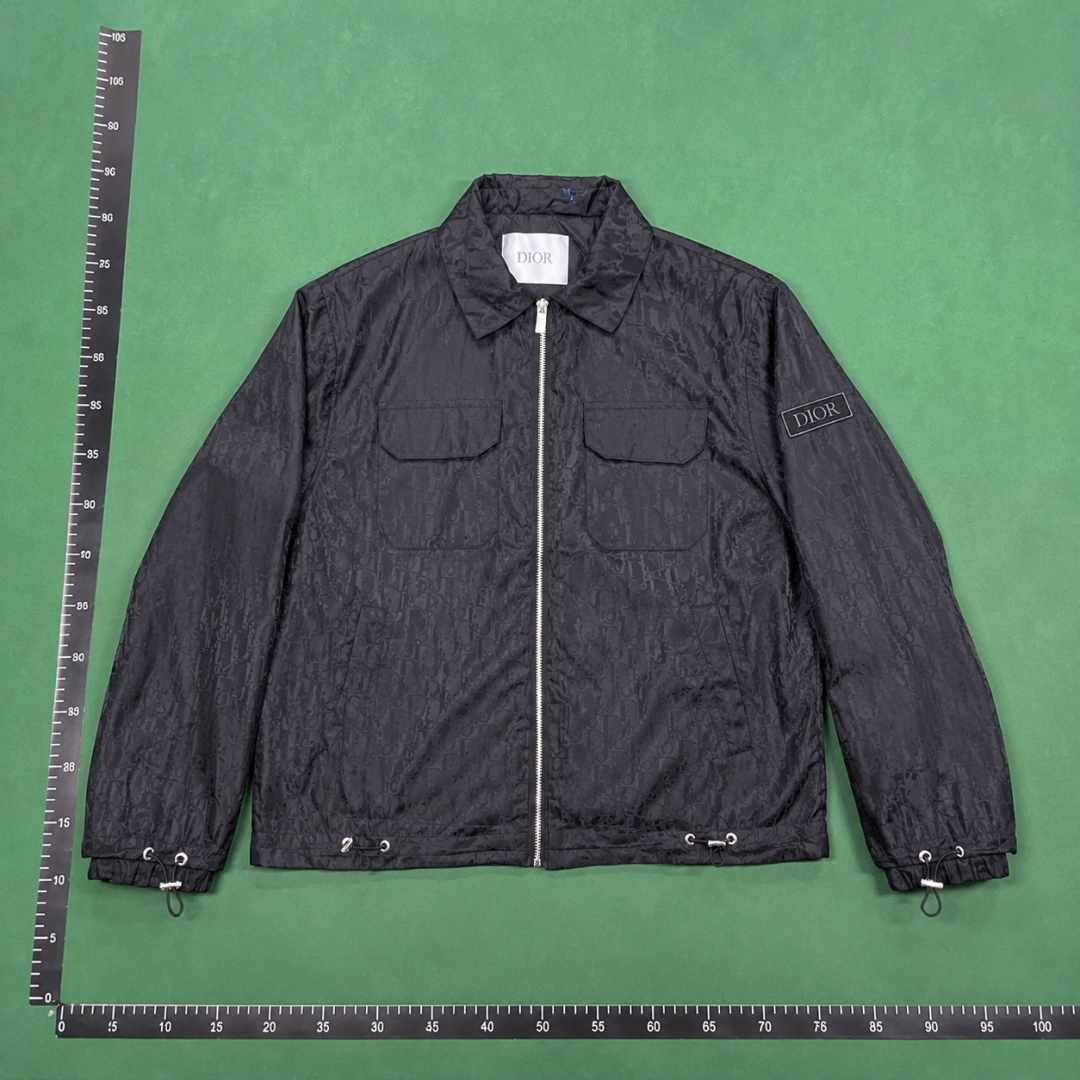
After entering the corresponding product details page, click View QC Photos on the page to check the QC images of this item: Dior black zipper jacket. The page information shows a dark all-over print, lapel collar, chest pocket, and offers three letter sizes: M, L, and XL.

The above image only corresponds to the QC record of this Dior black jacket. What is actually visible in the image can be used as product evidence; the following handling suggestions are editorial judgments and cannot replace authenticity verification, quality assurance, or seller confirmation.
First Confirm the Images Are Not the Wrong Product
After opening the QC photo gallery, don't rush to inspect the workmanship. First confirm that the images show the same product:
- Is the color black, and does it match the page description?
- Is it a zipper closure, lapel collar, and chest pocket style?
- Does the position and direction of the dark all-over print match the description of this style?
- Do any other styles, other colors, or different size labels appear in the images?
- Is the number of images sufficient to cover the front, back, collar, cuffs, zipper, and size label?
If the gallery includes other Dior jackets, or the images cannot confirm the corresponding style, you should pause judgment and ask the seller to provide complete QC images of this item, rather than using photos of other styles as substitutes.
Check Visible Details by Area
Zipper and Hardware
Check whether the zipper extends from the collar to the hem, whether the left and right chain tapes are basically straight, and whether the zipper teeth have obvious gaps, misalignment, or partial detachment. The zipper pull, fasteners, and other metal parts should be enlarged and observed one by one:
- Are there obvious scratches, color loss, oxidation, or deformation?
- After zipping closed, are there obvious waves, signs of sticking, or uneven heights on both sides?
- Are the letters, engravings, or logos on the hardware clear and legible?
- Do not judge material, color accuracy, or brand authenticity just because of metal reflection or photo compression.
If there are no close-up photos of key hardware areas, the safest approach is to request additional photos rather than writing "no problem" for something you cannot see clearly. If the photos already show broken zipper teeth, a detached pull, or obvious deformation, you can pause shipping and ask the seller for a solution.
Collar, Body, and Seams
The page description for this item includes a lapel collar, chest pocket, and dark all-over print. When checking, record structural facts separately from aesthetic judgments:
- Is the lapel roughly symmetrical on both sides, and are there obvious collapses, twists, or creases at the folds?
- Are there obvious loose threads, bunching, or unevenness at the connection between the collar and the placket?
- Is the chest pocket position, flap, and edge basically aligned?
- Are there skipped stitches, missed seams, concentrated loose threads, or obvious pulling at the front and back body seams?
- Does the print show obvious misalignment, breakage, or abnormal overlapping at the placket, shoulders, and seams?
Photo angles, clothing placement, and lighting can affect judgment. Slight wrinkles should not be directly equated with structural defects; but if the same area appears crooked, bulging, with loose threads, or uneven seams in multiple photos, you should request additional close-up photos and have the seller confirm.
Cuffs, Hem, and Surface Imperfections
When checking cuffs and hem, focus on stitch continuity and left-right differences, not just whether there are stray threads:
- Is the cuff edging complete, with any obvious loose threads, holes, or asymmetry?
- Is the hem stitching continuous, with any obvious curling or local bulging at the edges?
- Are there stains, color differences, scratches, damage, or creases on the fabric surface?
- Does the print on the black garment show obvious color loss, blurred edges, or abnormal shiny spots?
Areas that cannot be confirmed from the current angles should be marked as "unconfirmed," not written as "no flaws." If flaws affect wearing, structure, or product identification, they should be addressed before shipping; details that cannot be ruled out from distant photos alone should be re-photographed first.
Size Label Cannot Replace Flat Measurements
The page information shows that this style uses letter sizes M, L, and XL. Do not directly convert EU numeric sizes from other Dior jackets or buyer feedback to this item. Different fits, padding amounts, and measurement methods may cause differences.
First check whether the size label actually belongs to this jacket and confirm that the letters are clear and legible. Then ask the seller for flat measurements that match your personal measurement method, at least including garment length, chest or underarm width, shoulder width, and sleeve length. For wear that requires inner layering, also confirm whether the measurement includes the natural thickness of the padding layer.
It is not recommended to ship directly based on the size label in the following situations:
- The size label is missing, blurred, or appears to belong to another garment.
- The page says M, L, XL, but the seller only provides numeric size information that cannot be matched.
- There are no flat measurements, and the buyer needs a clear fit or layering room.
- The size label is inconsistent with the seller's verbal explanation.
Keep Evidence and Decisions Separate
You can record in the format of "photo facts – unconfirmed items – next step decision" to avoid writing subjective judgments as QC conclusions. For example: the photos show the zipper and lapel, but there is no close-up of the inside of the cuffs; therefore, you should request additional photos of the cuffs, size label, and zipper pull instead of continuing to ship.
It is recommended to complete at least these three types of confirmation before shipping:
- Product identity: color, style structure, and print match the target item.
- Key details: zipper, lapel, chest pocket, cuffs, seams, and obvious flaws are covered from enough angles.
- Size information: the size label corresponds to the item, and flat measurements for comparison have been obtained.
Currently verifiable information can confirm the product page and its View QC Photos entry, and can confirm the page description of black zipper, dark print, lapel collar, chest pocket, and M, L, XL; but if a specific part cannot be clearly identified in the original QC images, you cannot assert that the part is qualified, flawless, or consistent with the authentic product.
When to Request Additional Photos, Pause, or Continue
Suitable situations for requesting additional photos are when key parts lack close-ups, the images are too dark, angles are blocked, or the size label cannot be read. The request should specify the parts, such as the front and back of the zipper pull, the connection between the collar and the placket, both cuffs, the edge of the chest pocket, body seams, and the complete size label.
Suitable situations for pausing shipping are when obvious loose threads, damage, hardware deformation, severe print misalignment, size label mismatch, or the seller cannot explain style differences in the images are already visible. The reason for pausing should correspond to visible evidence and should not be expanded to an authenticity conclusion.
Only when the product identity is clear, key areas have clear images, obvious flaws have been eliminated or addressed, and the size label and flat measurements correspond, is it appropriate to continue verifying shipping information. QC images can help determine structural and workmanship issues visible in the photos, but they cannot alone guarantee authenticity, actual wearing effect, or final quality.