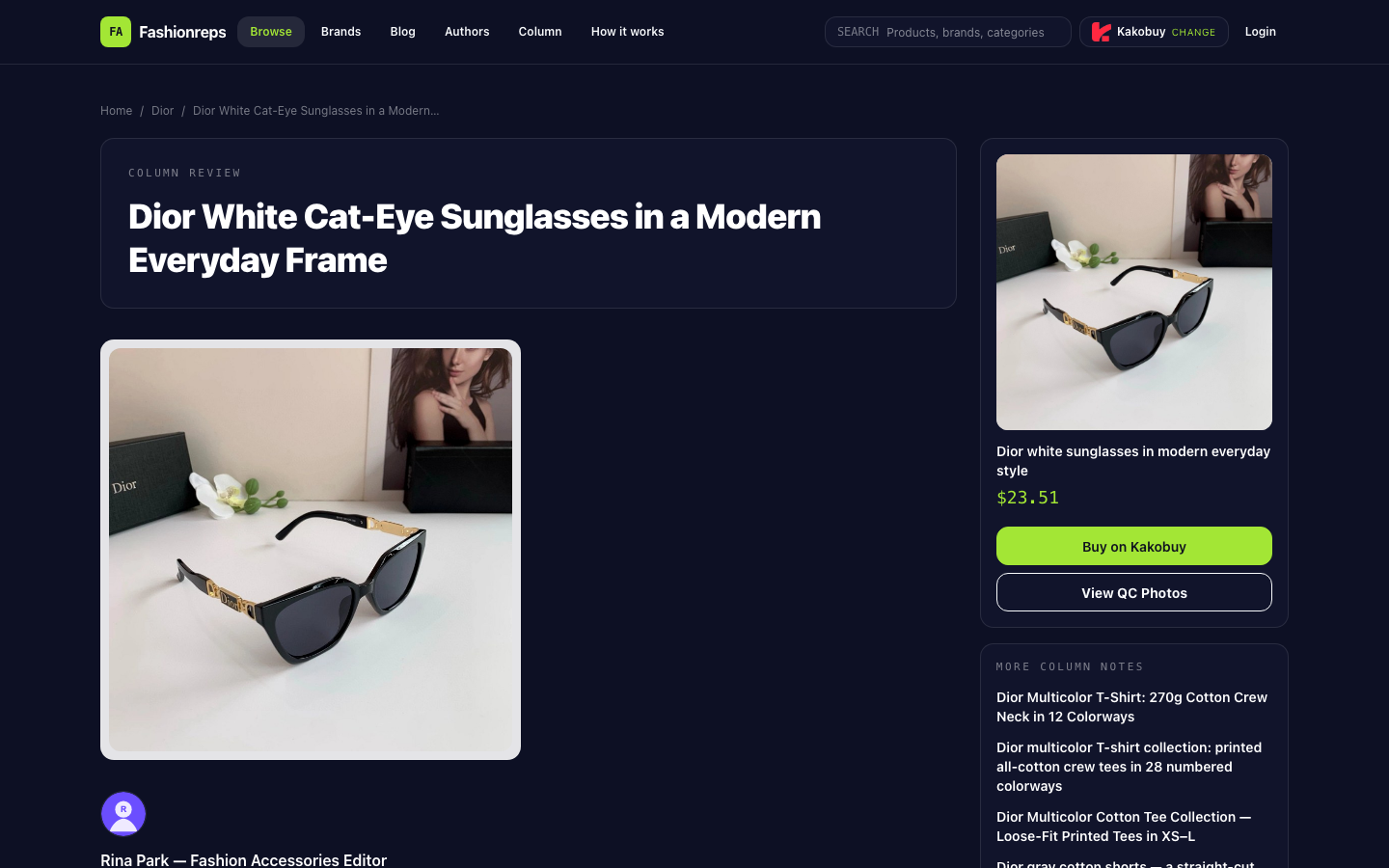
If you're considering buying these Dior white cat-eye sunglasses, the most important thing to confirm right now is not the color, but whether they fit your face shape and daily wear. The current page confirms the white color, cat-eye silhouette, and unisex positioning, but does not provide lens width, bridge width, or temple length, nor any independent buyer feedback for this white frame. Therefore, before ordering, you should first fill in information about sizing, hinges, and lens markings.

What the page currently confirms
This product is described as a white cat-eye frame, aimed at both men and women. The page shows a reference price of $23.51, with another price of $27.86; the final product price, service fees, and international shipping should be based on the shopping agent's checkout page, not just the reference price.
The page does not list lens width, bridge width, temple length, total frame width, or lens material. There is also no evidence that it has any specific protective, optical, or durability performance.
Four types of information to request from the seller before ordering
1. Ask for complete dimensions first
It's recommended to ask for the following data at once, and require the seller to use the same units:
- Lens width (single lens)
- Bridge width
- Temple length
- Total frame width
If you have a pair of comfortable sunglasses on hand, you can directly measure their total frame width and temple length, then compare with the seller's data. The cat-eye silhouette usually makes the upswept outer corners more noticeable, so you can't judge visual size by lens width alone; total frame width is especially important.
If the seller can only provide blurry photos and cannot give millimeter dimensions, don't interpret "unisex" as meaning it fits all face shapes. This label only indicates the page's positioning, not a substitute for actual measurements.
2. Check the hinges and temple connections
The page does not provide structural details for this white frame. Before ordering, you can ask the seller to clarify:
- Whether the hinges are metal, plastic, or another structure
- Whether the temples open and close smoothly, and if there's any noticeable looseness
- Whether the connection between the temples and the front frame is skewed, has glue overflow, or gaps
- Whether the temples are symmetrical when naturally closed
Existing public feedback mentions that the metal hinges and temples of another Dior sunglasses model can hold their shape, but this is not a direct verification of the white cat-eye model; it only serves as background information for other models of the same brand, not a quality conclusion for this model.
3. Request lens markings and basic descriptions
If you care about lens purpose, ask the seller whether they can provide brand markings, model markings, or other identifiable information on the lenses, and request close-up photos. Also confirm whether there are obvious scratches, bubbles, edge chips, or inconsistent colors between left and right lenses.
Do not infer from the product name that the lenses have UV protection, polarization, or other functions. Current materials do not support evidence of these specific performances; if these features are important to you, ask the seller for clear statements and corresponding evidence.
4. Request physical or QC angle photos
The page provides an entry to view QC photos by style, but the existing text does not prove that these photos have resolved sizing and structural issues. You can focus on requesting the following angles:
- Front flat lay, to observe left-right symmetry
- Side view of the frame, to observe front curvature and temple angle
- Close-up of the hinge, to inspect connections and gaps
- Inner side of the temple, to view markings
- Close-up of lens edges and nose pad area
These photos can only help you check visible details; they cannot replace wearing experience, nor prove lens performance.
How to decide whether it's worth continuing the order
Situations suitable for further checking: you like the white cat-eye silhouette, you can accept first supplementing dimensions from the seller, and you don't take the page's reference price as the final cost. As long as the seller can provide relatively complete dimensions, hinge photos, and lens marking information, at least a basic fit judgment can be made.
Situations to hold off: you must rely on specific dimensions to decide; the seller cannot provide lens width, bridge width, and temple length; or you need independent wearing feedback for this specific model. Currently the page has no independent buyer evidence for these white cat-eye sunglasses; the only visible Dior feedback is from another product.
If the seller just repeats descriptions like "unisex" or "versatile for daily wear" but cannot answer structural and sizing questions, it's advisable not to treat it as a verified purchase recommendation. For sunglasses, frame width, temple length, and hinge condition matter more to actual experience than generic style descriptions.
Final checklist
Before ordering, at least confirm the following:
- Lens width, bridge width, temple length, and total frame width
- Hinge material or structural description, and close-up photos of connections
- Whether the temples are symmetrical and if the opening/closing is loose
- Lens markings and close-up photos of lens surfaces
- Service fees and international shipping beyond the reference price
- Whether this information indeed corresponds to the white cat-eye model, not another Dior sunglasses
A more prudent conclusion at this point: the product's appearance positioning and reference price are supported by page information, but wearing dimensions and structural evidence are still incomplete. Only after the seller supplements key information can you further judge whether it's worth buying.